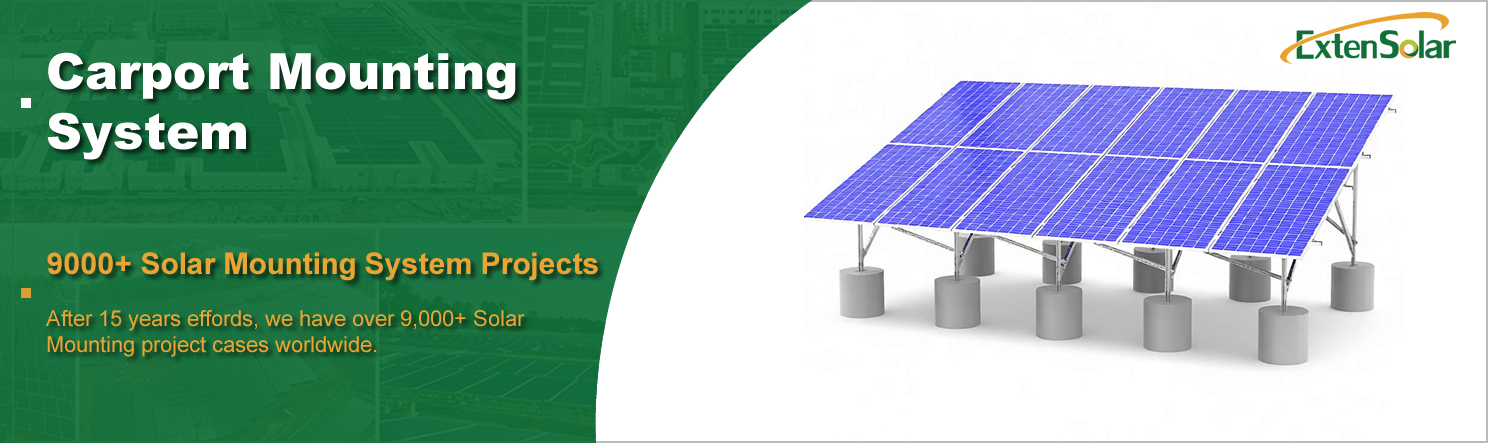
Details
| Surface Treatment |
Anodized |
Material |
Carbon steel Mg-Al-Zn Coating / Hot-dip galva ized |
| Place of Origin |
China |
Installation Site |
Open Field |
| Brand Name |
Exten |
Model Number |
A02-1 |
| Standard |
|
Certificate |
AS/NZS1170.2/CE/ISO |
| Wind Load |
60m/s(196.85ft/s) |
Module Orientation |
Landscape Portrait |
| Wind speed |
Yo 60m/s |
Max Snow Load |
1.4KN/m2 |
| Snow Load |
1.4KN/m2(29.24psf) |
Service Life |
25YRS |
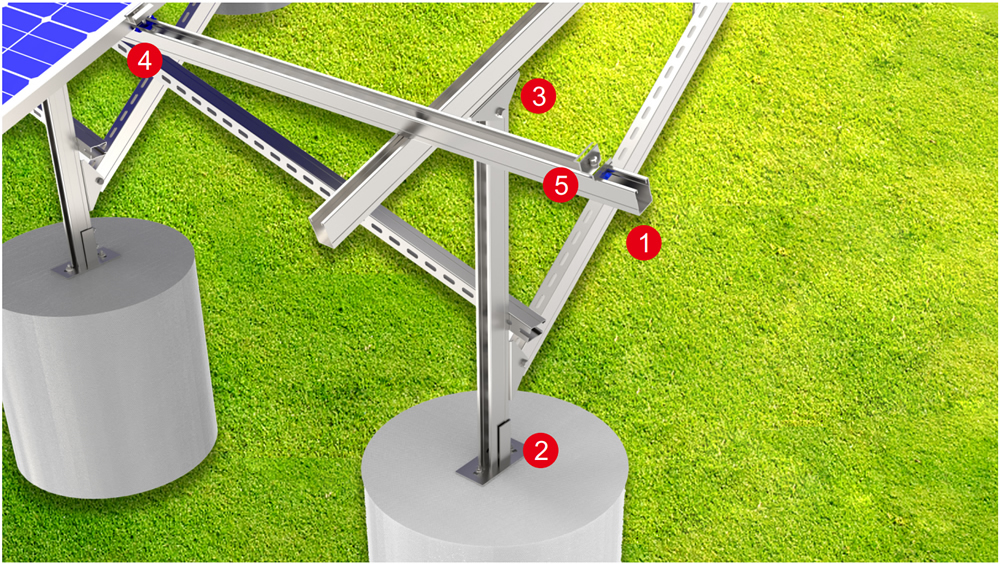
Component List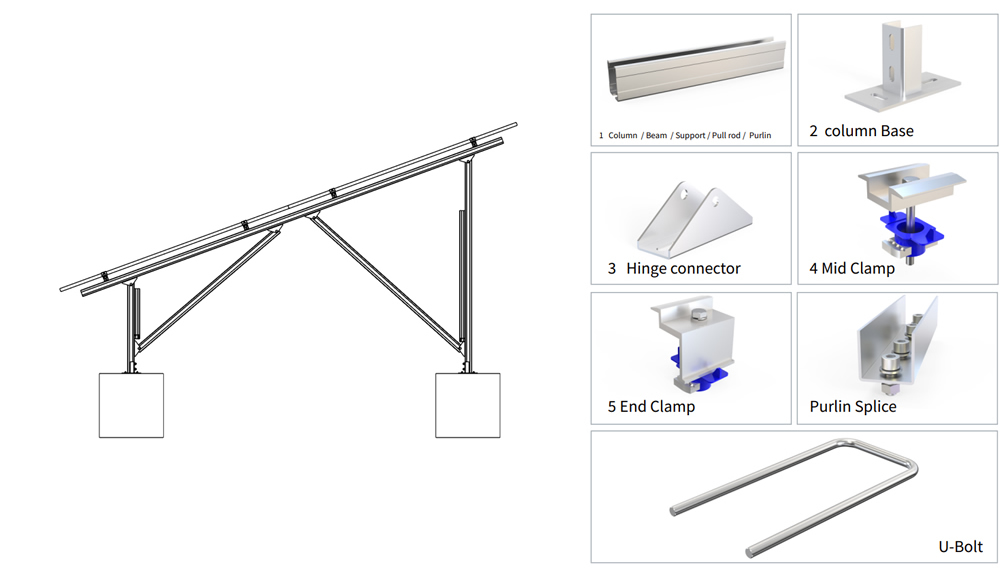
| Description |
Material |
Specificatioin |
Quantity |
| Beam |
Q235B |
4200mm |
5 |
| Purlin |
Q235B |
7100mm |
4 |
| Column Support 01 |
Q235B |
1700mm |
4 |
| Column Support 02 |
Q235B |
2000mm |
4 |
| Beam Support 01 |
Q235B |
1735mm |
5 |
| Beam Support 02 |
Q235B |
1880mm |
5 |
| Column 01 |
Q235B |
852mm |
5 |
| Column 02 |
Q235B |
2005mm |
5 |
| Hinge Connector |
Q235B |
|
30 |
| Column Base |
Q235B |
|
10 |
| Mid Clamp |
AL 6005-T5 |
50mm |
20 |
| End Clamp |
AL 6005-T5 |
50mm |
8 |
| U-Bolt |
Q235B |
mm |
10 |
CarbonSteel Mg-Al-Zn Coating Ground Mount Solar Frames Overview
The carbon steel Mg-Al-Zn coating ground mount solar frame is a PV installation solution that combines high-strength structural steel with advanced coating technology. At its core, the system employs an alloy coating containing magnesium, aluminum, and zinc to provide comprehensive protection for the carbon steel substrate. The coating possesses a unique self-healing capability at cut edges and scratches, actively inhibiting the spread of corrosion. This system is suitable for the rapid deployment of large-scale ground-mounted power plants and offers significant advantages, particularly in projects with stringent requirements for structural strength, corrosion resistance lifespan, and total life-cycle costs.
CarbonSteel Solar Panel Racking System Ground Mount Advantages
Corrosion resistance surpasses that of traditional hot-dip galvanizing.
The salt spray test lifespan of the magnesium-aluminum-zinc coating is more than twice that of a hot-dip galvanized coating of equivalent thickness. In corrosive environments such as coastal areas with high humidity, industrial pollution, or agricultural ammonia, its resistance to red rust is particularly outstanding, ensuring that the mounting system maintains structural integrity throughout its 25-year design life.
Self-healing properties of cuts reduce maintenance risks.
The magnesium in the coating gives the material a unique ability: when scratches or cuts occur on the mounting structure during transportation or installation, the coating forms a dense, protective migration film that covers the exposed metal edges, effectively preventing corrosion from spreading inward from the damaged area, eliminating the need for subsequent touch-up coating.
The design balances high strength with lightweight construction.
The yield strength of the carbon steel substrate is significantly higher than that of aluminum alloy, allowing for smaller cross-sectional dimensions to support the same load from photovoltaic modules. This means that, for equivalent structural strength, less steel is required, keeping the overall system weight manageable while reducing the load-bearing requirements for the foundation.
More competitive full life-cycle costs.
Although the raw material cost is slightly higher than that of ordinary galvanized steel, thanks to a longer corrosion protection lifespan and virtually zero maintenance requirements, magnesium-aluminum-zinc-coated mounting structures significantly reduce the levelized cost of electricity (LCOE) over the power plant’s 25-year operational cycle, making them particularly suitable for large-scale procurement in major projects.
Rapid supply chain response.
The supply channels for carbon steel raw materials are mature and stable, and the profile processing and coating treatment are highly automated in the factory. With short product delivery cycles, the system can flexibly adapt to adjustments in project schedules, avoiding construction delays caused by material shortages.
CarbonSteel PV Ground Mounting Systems Installation
Step 1: Site Survey and Test Drilling. Before formal construction begins, test drilling is conducted at several representative locations to record the actual insertion torque and the depth reached at the bearing layer, which are used to finalize the design parameters for each pile.
Step 2: Screw Pile Installation. Using hydraulic screw pile equipment equipped with a torque monitoring system, the screw piles are driven vertically into the ground according to the staked-out coordinates. The torque curve is monitored in real time during construction to ensure that the bearing capacity of each pile meets design requirements.
Step 3: Assembly of Uprights and Crossbeams. Prefabricated aluminum alloy uprights are secured to the tops of the ground piles using connection brackets. Diagonal beams and transverse support members are then installed. A level and theodolite are used to perform preliminary adjustments to the support structure’s plane, ensuring the overall flatness meets the installation tolerances for the modules.
Step 4: Mounting of Photovoltaic Modules. The photovoltaic panels are laid sequentially on the aluminum alloy rails and secured using specialized clamps and anti-loosening bolts. Subsequently, ground bonding between modules is completed, and the electrical connections of the entire array are inspected.
Step 5: Final torque verification and site cleanup. A final torque check is performed on all fastening bolts. Once verified, construction debris and equipment are removed from the site, and the mounting system proceeds to the electrical commissioning and grid-connection preparation phase.
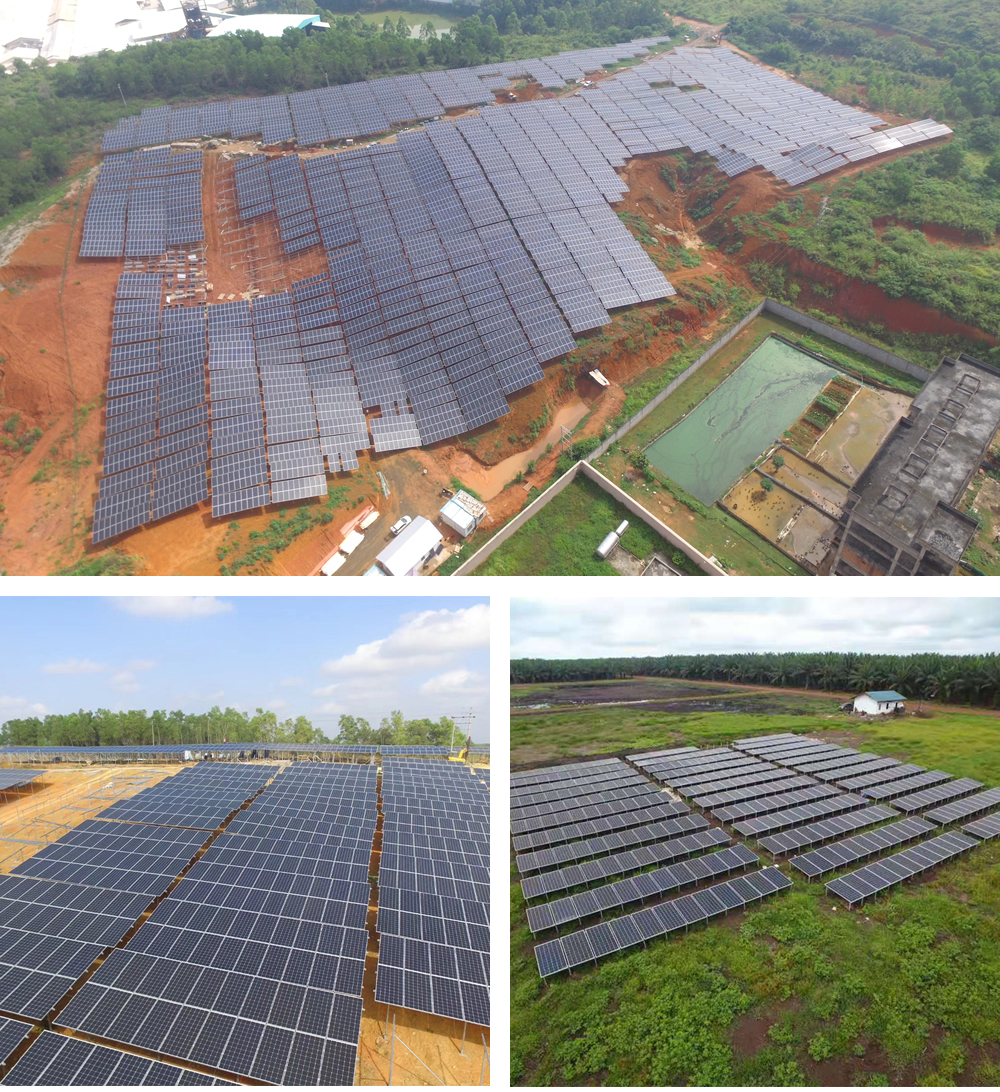
Helical Piles Ground Mount Solar Frames Case
FAQ
Q1: What is the difference between a magnesium-aluminum-zinc coating and a standard hot-dip galvanized coating?
A1: The main differences lie in the coating composition and self-healing capability. The magnesium-aluminum-zinc coating contains magnesium and aluminum, which form a protective migration layer at cut edges to inhibit corrosion spread. Standard hot-dip galvanized coatings lack this property; at equivalent thicknesses, their salt spray resistance is only about half that of the former.
Q2: Does a scratched coating require on-site touch-up?
A2: Generally, no. For minor scratches and cuts, the magnesium in the coating triggers a self-healing mechanism, forming a dense protective layer over the exposed metal. Localized repairs are recommended only for deep scratches that penetrate the entire coating and cover a large area.
Q3: Can this bracket be used in coastal areas with high salt fog levels?
A3: Yes. The magnesium-aluminum-zinc coating has been validated through neutral salt fog accelerated testing and performs stably in high-salt-fog environments with a corrosion class of C5 or higher. During design, the appropriate coating thickness should be selected based on the corrosion environment class of the project site to ensure system safety and redundancy.


