Thesolar pv mounting rails that are core components connecting components and supporting structures in photovoltaic systems act in several ways, like transmitting loads, ensuring component flatness, and providing grounding continuity.Over the past ten years, the design and manufacture of solar pv mounting rails have changed from a crude way to a refined one.
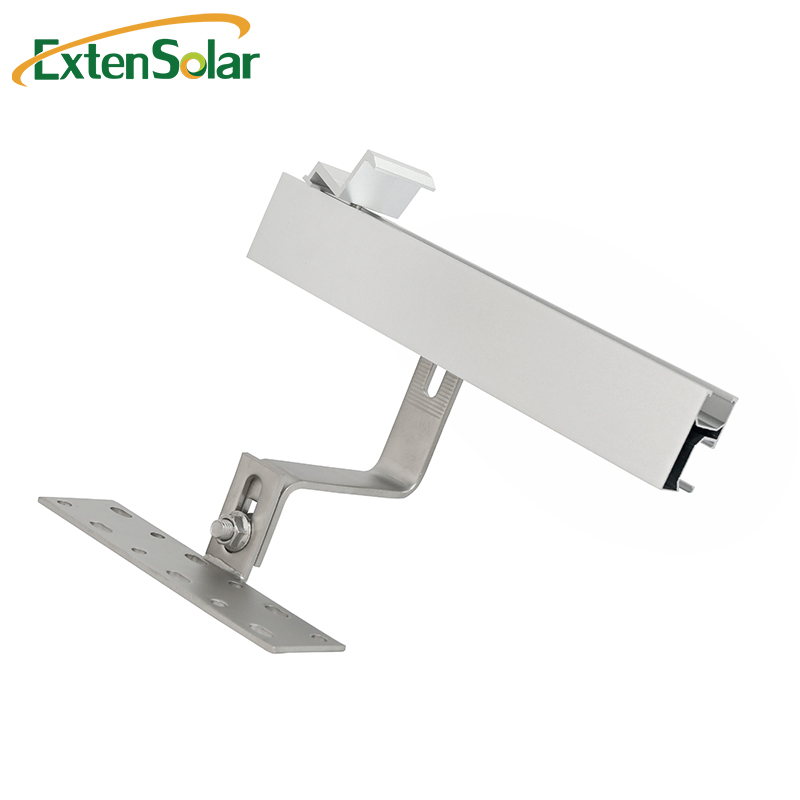
Looking into the next decade, this seemingly uncomplicated extrusion profile product will experience more profound changes. The progress in materials science, the paradigm shifts in structural design, and the penetration of digital technology will all together redefine the shape and the value of solar pv mounting rails.
The changes at the material level first emerged in the steel field. The traditional hot - dip galvanized steel, which is still the mainstream material for solar pv mounting rails, has its grades and coatings changing rapidly indeed.The extensive application of high-strength low-alloy steel makes the solar pv mounting rails able to attain the same load - bearing capacity with thinner walls, thereby directly reducing the quantity of steel used per watt.Meanwhile, the coating technology develops from pure zinc to zinc-aluminum-magnesium (ZAM) and zinc-aluminum-magnesium alloy (Super Dima). These new coatings, when compared with traditional zinc coatings, do have a considerably stronger self-healing ability at the cutting edges indeed.For solar pv mounting rails the anti-corrosion of the field cutting end used to be a weak link but now these new coatings are solving this problem. In the following five years high-corrosion-resistant products with a magnesium content between 3% and 11% will become the standard of solar pv mounting rail systems thus ensuring that the service life of the rails in coastal and high-humidity environments can reliably exceed 25 years.
The proportion of aluminium used in photovoltaic support rails will gradually increase. Aluminium has a density that is only one third of that of steel and is itself corrosion-resistant without the need for additional coating treatment.For flat roofs and light steel structures, the plan of using aluminum alloy to make solar pv mounting rails can significantly relieve the concerns regarding the load - bearing of the roofs.In the past, the main limitations of aluminum alloy solar pv mounting rails were the higher cost and the lower elastic modulus. As for the high cost, it can be solved by optimizing the cross - sectional shape so as to reduce the material usage per unit length. And for the low elastic modulus, it can be compensated by increasing the moment of inertia of the cross - section or using closed - section profiles. It is worth mentioning that the cost - performance ratio of high - strength aluminum alloys (such as 6061 - T6 and 7075 - T5) is on the rise, and their application in solar pv mounting rails is spreading from coastal projects to general projects as well.
The direction of innovation in structural design lies in topological optimization and parameter generation. The traditional solar pv mounting rail uses a design of constant cross-section, that is, the rail keeps the same cross-sectional shape and wall thickness along its entire length.Although this method is fairly simple, its material utilization rate is not very high as well.Rail's various sections have bending moments that are greatly different. The central part has the largest bending moment, and the ends have much smaller ones. The concept of variable - cross - section solar pv mounting rails through topological optimization is transitioning from academic research to engineering application.By adjusting the web height or flange width along the length direction, the solar pv mounting rail can retain materials in the areas of high - stress concentration and greatly reduce the excessive materials in the areas of low - stress. This kind of design method, which has been rather mature in the aerospace and automotive fields, is now being adopted by the photovoltaic mounting industry.Preliminary calculations show that the variable - cross - section photovoltaic installation guide rail can reduce the material consumption by 12% to 18% in comparison with the traditional equal - cross - section design and can also keep the same or even better deflection control.
The simplification of connecting nodes is a core element for the functional upgrade of the photovoltaic solar pv mounting rails. In the past, the connection of the guide rails relied on multi-bolt connection, leading to very cumbersome on-site installation procedures and inconsistent torque control.A newly developed generation of solar pv mounting rails is being introduced with a self-locking snap connection and a rapid installation clamping system, which cuts down the connection steps from four steps to only one step.More importantly, the integrated design of the railway connection node with the grounding function is becoming quite common. In the traditional solutions, the railway grounding needs to additionally use grounding wires and perforated washers; now, through the toothed structure and conductive coating of the connector itself, the solar pv mounting rail can achieve grounding only through connection.This function integration, which reduces the kinds of materials and installation steps, directly contributes to lowering the costs of the building operation system.
The selection and layout of solar pv mounting rail systems are being transformed by digital design tools. In the past, engineers relied on empirical formulas and standard design manuals to carry out rail design, which led to relatively limited accuracy and efficiency in the calculations.Nowadays the BIM (Building Information Modeling)-based photovoltaic installation design platform can automatically import roof models, meteorological data, and component layout plans and within a few seconds the generated optimal photovoltaic installation guide rail layout comes into being.There are built - in finite element solvers in these platforms. They can calculate the stress and displacement of each railway section in real time and automatically adjust the span and connection points to meet the requirements of the specifications. For large - scale commercial and industrial roof projects, the digital design makes the material quantity error of photovoltaic installation rails reduce from 5% - 8% of the traditional method to less than 1%.This can not only minimize the material waste but also enhance the accuracy of the purchasing planning.
The quality consistency and production efficiency of the solar pv mounting rail systems will be enhanced through intelligent manufacturing processes. The traditional roll forming production lines are being substituted by closed-loop control systems that have on-line inspection.By installing the laser profile projector and the wall thickness measuring instrument at the outlet of the roll forming machine, the dimensional and wall thickness deviation conditions of each meter of the solar pv mounting rail can be monitored in real time.When the deviation goes beyond the preset threshold, the control system automatically adjusts the roll gap or tension parameters. This closed - loop manufacturing method causes the dimensional tolerance of the solar pv mounting rails to be reduced from the original ±0.Within a range from 3 millimeters to about ±0.1 millimeter, which is extremely important for ensuring the stable fitting between the installed bracket and the guide rail.More precise dimensions result in less on-site adjustment and a more uniform load distribution, thereby indirectly improving the reliability of photovoltaic modules.
The concept of full life cycle management is introduced into the operation stage of photovoltaic support systems. As for the photovoltaic power stations that have already been put into operation, the current structural health assessment of the rails mainly depends on visual inspections, which makes it hard to detect early problems.A new method is to embed fiber Bragg grating sensors or resistance strain gauges in the key parts of solar pv mounting rails so as to monitor strain and temperature changes, thereby being able to detect abnormal deformations or loose connections.The data coming from these sensors is uploaded to the cloud platform through wireless gateways and then analyzed with artificial intelligence algorithms to recognize trends. When abnormal fluctuations in strain readings are detected, the system automatically sends early warning notifications to the operation and maintenance team.Although the cost of this active monitoring solution is currently rather high, with the decrease in sensor prices, its application in large power plants will become economically feasible in the following five years.
Looking into the next decade, the solar pv mounting rail system that are simple structural components will become intelligent components integrating structural support, electrical connection, condition monitoring and installation guidance. In regard to materials, high - strength steel, aluminum alloy and composite materials used jointly can work out customized schemes for diverse situations.In terms of design, the variable cross-sections and topology optimizations and the like will cause the efficiency per kilogram of the material to reach the maximum.In the manufacturing industry, end-to-end online inspection can make sure that the product quality reaches the highest consistency. In terms of digitization, BIM design and intelligent monitoring will cover the whole life cycle of solar pv mounting rails, from selection to abandonment and disuse and so forth.Generally speaking, these transformations will lead the solar pv mounting rails to develop towards higher reliability and wider applicability, and at the same time continuously reduce costs, thus providing a solid technical basis for the further promotion of global distributed photovoltaic.


