In the photovoltaic industry, the solar mount flat roof has long faced a core problem: they need to offer sufficient structural strength to resist wind and snow loads and at the same time attempt to minimize the load on the existing building roof as much as possible.
The traditional solutions usually become "over - designed" by thickening steel thickness and increasing structural redundancy to ensure safety.However, this directly leads to higher material costs, increased transportation costs, and greater construction complexity than.Nowadays, this industry is at a new turning point—lightweighting is not merely "reducing weight" but a systematic transformation that involves material science, structural mechanics and manufacturing processes.
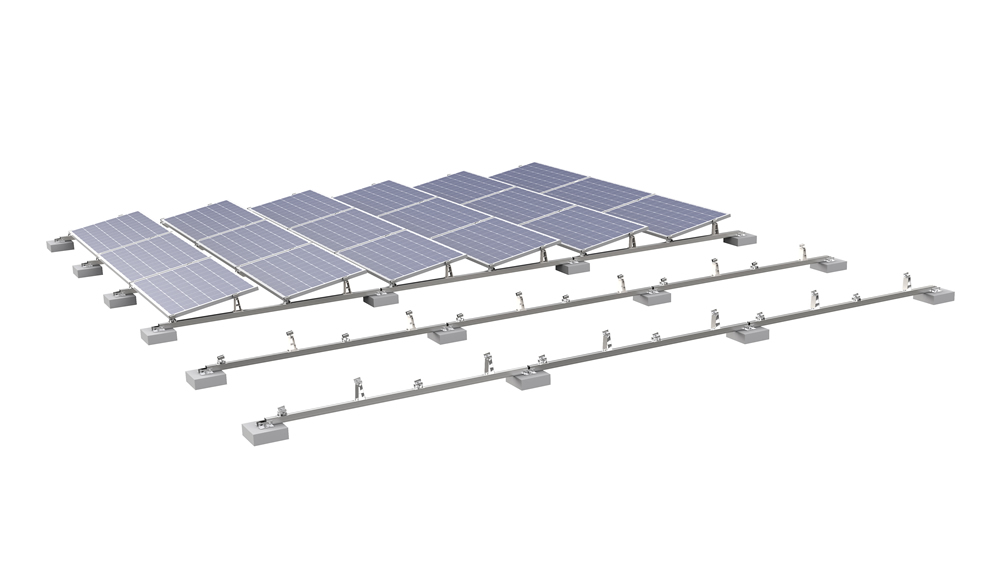
The lightening of the solar mount flat roof mainly originates from the breakthroughs in materials. Although the traditional hot - dip galvanized steel has a good cost - performance ratio, it has a high density, and then this makes its own weight often become a bottleneck in the design when applied to flat roofs that need large spans.In recent years, the introduction of high-strength low-alloy steel (HSLA) is indeed gradually changing this specific situation.Through the microalloying technology and the controlled rolling and controlled cooling process, the yield strength of the new generation steel has been made to be over 550 megapascals or even higher. This implies that designers can, while maintaining the same load - bearing capacity, use thinner wall thicknesses.For a standard megawatt - class solar mount flat roof, this alone can result in a reduction of approximately 15% to 20% in steel consumption. At the same time, the applicability of the aluminum alloy installation system in flat - roof application is being re - evaluated.Although the elastic modulus of aluminum alloy is only one third of that of steel, its density advantage is indeed quite obvious.Additionally, by optimizing the cross - sectional shape for example adding ribs or using profiled materials with closed sections an ideal balance can be achieved between controlling deflection and reducing weight. Some cutting - edge projects have even started piloting glass fiber reinforced composite GFRP whose corrosion resistance and insulating properties provide an extra safety margin for solar mount flat roof yet currently cost remains the main obstacle to large - scale adoption.
Second, the paradigm shift in structural design can be seen as the second driving force for the lightening of the solar mount flat roof. In the past, the design principle was mostly based on the "equal strength" concept, that is, to equip all components with the same safety factor.Nowadays the topological optimization and parametric finite element analysis tools cause the design to be "quite precise" indeed.Through computational fluid dynamics (CFD) simulations, we can clearly see the turbulent and negative pressure regions when the wind sweeps over the edge of the flat roof. Based on this, the solar mount flat roof no longer needs to be uniformly and densely arranged with ballast blocks all over the area; instead, it can adopt "zoned and differentiated design": with reinforced anchoring and additional ballast in the high negative pressure areas at the roof edge and with simplified connectors in the central core area.This "using the right tool to do the right thing" strategy together with innovative systems like prestressed cables or tension - integrated structures has remarkably enhanced the overall material efficiency of solar mount flat roof. For example, replacing the traditional rigid connection between the front and rear columns with a hinged system having tension members makes it so that the prestress can counteract part of the working load, resulting in the maximum bending moment of the main beam being reduced by nearly 30 percent.
Additionally achieving a lightweight structure depends on the collaborative innovation of connecting nodes and installation processes. The on - site welding or a large number of bolt connections in the traditional solar mount flat roof not only take time but also are likely to cause additional stress because of construction errors.The new method makes use of prefabricated modules and that kind of snap - fit, bolt - free connection technology.The solar mount flat roof is divided into standardized grid units that are pre - assembled and drilled in the factory. In this manner, the on - site installation only needs simple positioning and locking operations. This not only decreases the amount of high - altitude work, but more importantly, eliminates the weakened reinforcing plates that are caused by drilling of compensation connection points and further reduces the redundant weight.Meanwhile in order to solve the specific problem of protecting the flat roof waterproof layer the lightweight installation system together with the new roof penetration anchoring system such as chemical anchors or vacuum adsorption bases can directly transmit the force of wind suction to the structural layer of the building without damaging the existing waterproof layer thus completely doing away with those bulky concrete ballast blocks. This transformation is extremely innovative the weight of the solar mount flat roof can be greatly reduced from the original 15 to 20 kilograms per kilowatt to the range of 8 to 10 kilograms which greatly expands the feasibility of installing photovoltaic systems on old factories and light steel structures.
Ultimately the ultimate goal of this new trend towards lightweight design is to maximize value throughout the entire life cycle. The lighter solar mount flat roof mean less fuel consumption during transportation, reduced requirements for the tonnage of lifting equipment, and faster installation speeds - all of which directly translate into economic benefits for commercial and industrial distributed projects.Take a typical 1 - megawatt flat - roof project as an example, the fact that the weight of the installation system is reduced by 20% can result in the saving of about 5 metric tons of steel.With the decrease of labor costs, the cost of the entire balance of system (BOS) is approximately reduced from about 0.05 to 0.At 0.08 yuan per watt. Moreover, the reduced load makes the roof possess flexibility, and in the future, it can accommodate additional equipment like energy storage systems or cleaning robots and the like.
The lightweight design of the solar mount flat roof is by no means simply "cutting corners" but a scientific approach based on precise calculations and advanced materials. It turns the photovoltaic system from a "burden" on the building into a "functional level" of the structure.With the wide - spread application of domestic high - strength steel and the in - depth use of digital design tools, the solar mount flat roof that is more aesthetic and economical will support the broad future of distributed energy and ensure the reliability of 25 years throughout the whole service life cycle.


