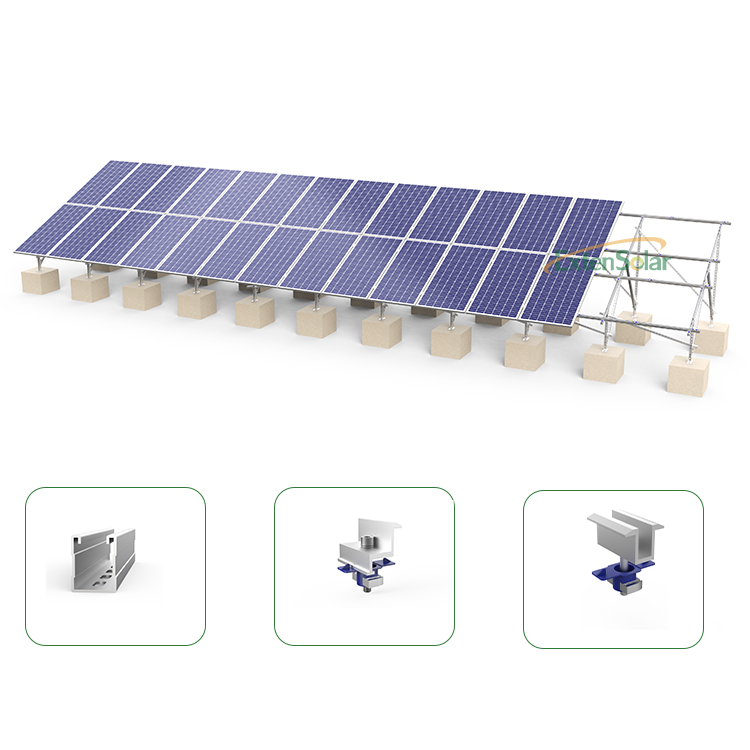
In the engineering practice of pv ground mount structure the balance between structural safety and economic efficiency has always been a core issue in design. For the fixed-installation structure the design usually follows the principle of rigid body statics that is passively resisting external loads by increasing the cross-sectional area and adding more supports.Yet, when we direct our attention to large - scale single - axis tracking systems, this traditional design concept no longer is the truly optimal solution.Such structures usually show characteristics of long-period and low-damping and their dynamic responses are fundamentally different from those of fixed supports. Under extreme typhoon conditions, continuously adopting static design methods will not only lead to a significant increase in steel consumption - making the project cost uncompetitive - but also may bring unknown safety risks because of the incorrect calculation of the actual stress state of the structure.
1. Limitations of Traditional Wind-Resistance DesignTraditionally the wind resistance calculation ofpv ground mount structures relies to a great extent on the wind pressure coefficients derived from wind tunnel tests or numerical simulations. These methods convert the time history of fluctuating wind speed into the average wind pressure and fluctuating wind pressure acting on the surface of structural components and then superpose them in a static equivalent manner.For the low - level and rigid structures, the assumption of this quasi - steady state is indeed applicable.However, the natural frequency of the pv ground mount structure is often relatively low, especially the torsional mode of the tracking system. When the dominant frequency of the wind load is close to a certain natural frequency of the pv ground mount structure, the resonance effect will be significantly amplified.In such situations focusing solely on the peak wind pressure while neglecting the structural acceleration response caused by wind speed changes is a basic mistake of regarding dynamic behavior as static. This is just like estimating the amplitude of an iceberg swaying in waves by measuring its size the two are completely in different physical categories.
2. The Core Mechanism of Aeroelastic EffectsIn order to precisely capture the real response of the pv ground mount structure during the typhoon, one has to introduce an aero - elastic model which is the concept of regarding the pv ground mount structure as an elastic body that is in an instantaneous flow field.When the incoming flow flows around the surface of the PV module, alternating eddies detach from their leeward sides; this phenomenon is called the Karman vortex street.For the pv ground mount structure the torsional stiffness is usually far lower than the translational stiffness. When the vortex shedding frequency approaches the torsional natural frequency of the structure a typical single-degree-of-freedom torsional flutter will be triggered.At this moment the pv ground mount structure is no longer passively bearing the wind pressure but actively obtaining energy from the flowing air, thus leading to the situation of amplified vibration.
Next, let's analyze the source of this aerodynamic instability. The angle of attack of the pv ground mount structure that is in torsional motion will change with time.According to the thin - wing theory, the slope of the lift coefficient before stall is unchanging, but in the dynamic process, there will be a lag effect of the lift coefficient.This implies that the aerodynamic force exerted on the pv ground mount structure does not vary along the identical path during the up - and - down oscillation. The area enclosed by this hysteresis loop signifies the net energy absorbed from the wind field by the structure within a single vibration cycle.When this net energy exceeds the energy that can be dissipated by the structural damping of the pv ground mount structure itself the amplitude will grow exponentially. For the photovoltaic modules installed on the installation system their length - width ratio and front area directly affect the magnitude of this aerodynamic negative damping.
3. Utilizing Active Control Strategies to Cope with TyphoonsBased on the above-mentioned mechanisms, the advanced pv ground mount structure design at present no longer continuously makes great efforts to increase stiffness in order to "resist" typhoons, but instead turns to make use of the air-elastic effect to "drain" and "alleviate" typhoons. There is a verified method which is the stall pitch control strategy.The control system is real - time monitoring the condition of the pv ground mount structure through anemometers and accelerometers.When the wind speed surpasses a particular threshold or the structural response presents an abnormal increase, the system will actively transfer the pv ground mount structure to a high angle of attack, resulting in flow separation on the surface of the photovoltaic module, thus artificially creating a stall situation. Once stall takes place, the lift coefficient will drop notably, the aerodynamic negative damping will vanish, and the vibration will be suppressed.
Additionally, spectral tuning is another significant passive design approach. The torsion frequency of the pv ground mount structure is precisely adjusted so as to avoid the energy - concentrated bands in the typhoon frequency domain, which is indeed a quite cost - effective option.This can be accomplished by changing the position of the torsion center of the pv ground mount structure or by adjusting the supporting rigidity of the installation columns.Compared with blindly increasing the amount of steel, this optimization design based on dynamic performance can create the best balance between the utilization of materials and structural safety. This design concept is quite significant in reducing the total cost of the pv ground mount structure.
4. Validation Methods and Engineering PracticeBefore the engineering implementation, the effectiveness of the aforesaid strategy has to be verified by making use of an aeroelastic model via wind tunnel tests. Different from the pressure measurement test of a rigid model, the aeroelastic model has to accurately simulate the mass distribution, stiffness matrix and damping ratio of the pv ground mount structure. During the test period, not only the pressure distribution on the surface of the pv ground mount structure is measured but also the time history of its displacement and acceleration is recorded.By comparing the critical flutter wind speeds of pv ground mount structures under different control strategies, the optimal pitch angle and response delay time can be identified.
In the actual engineering application, we also need to guard against the vortex-induced vibration brought about by the wake mutual interference between arrays. The vortices that are separated from the front-row pv ground mount structure may collide with those at the rear, leading to a flow field appearance that is entirely different from that of a single structure.When designing the layout of pv ground mount structures, this requires us to comprehensively consider the matters of space influence and wind direction angle in a thorough way.For the pv ground mount structures with high wind pressure in coastal areas, it is suggested to adopt more conservative damping ratio values and also appropriately increase the pitch start wind speed threshold, all of which are done to ensure that the structures can withstand extreme situations throughout the whole life cycle.


